
To Kill a Chicken

Call me racist, call me whatever you like, but I didn’t like the white ones. They’re noisy, with shrill voices that grate the ears. They’re bad mothers, and lazy loafers, always the first to quit work, heading home early while the black and brown ones pick up the slack. The whites want handouts, gobbling all the easy food while the colored ones scratch away with their bare nails just to get a meal. They peck your hands when you try to take eggs from their nest, and because their eggs are white, they’re always dirty. I don’t like dirty eggs.
If you think you’re more inclusive, more accepting, more patient, you’re probably right. But try for a few years to employ and instill some decency in those white leghorns, and I’d wager you wouldn’t judge me for what I did. Besides this, they’re getting old, and old chickens stop laying. Most importantly, our freezer is getting precariously low on stewing hens.
I couldn’t bring myself to get out of bed the other night, after reading fairytales to my daughter, and go to the chicken coop to round up those destined for this race-based execution. So, I woke early, filled the big steel pot I found at the dump with water, lit the gas on the outdoor stove, walked to the coop, positioned myself as the gatekeeper, and opened the small hen door. Out hopped a black, black, brown, cock, black, white! Gotcha. Any black or brown hens that didn’t look in peak health, missing feathers, or pale combs, also went to the crates. Buckets of feed thrown down, waters filled, and trip to the brewery for the kitchen scraps completed, I wheeled twenty-three poor leghorns away from the flock to the execution tree.
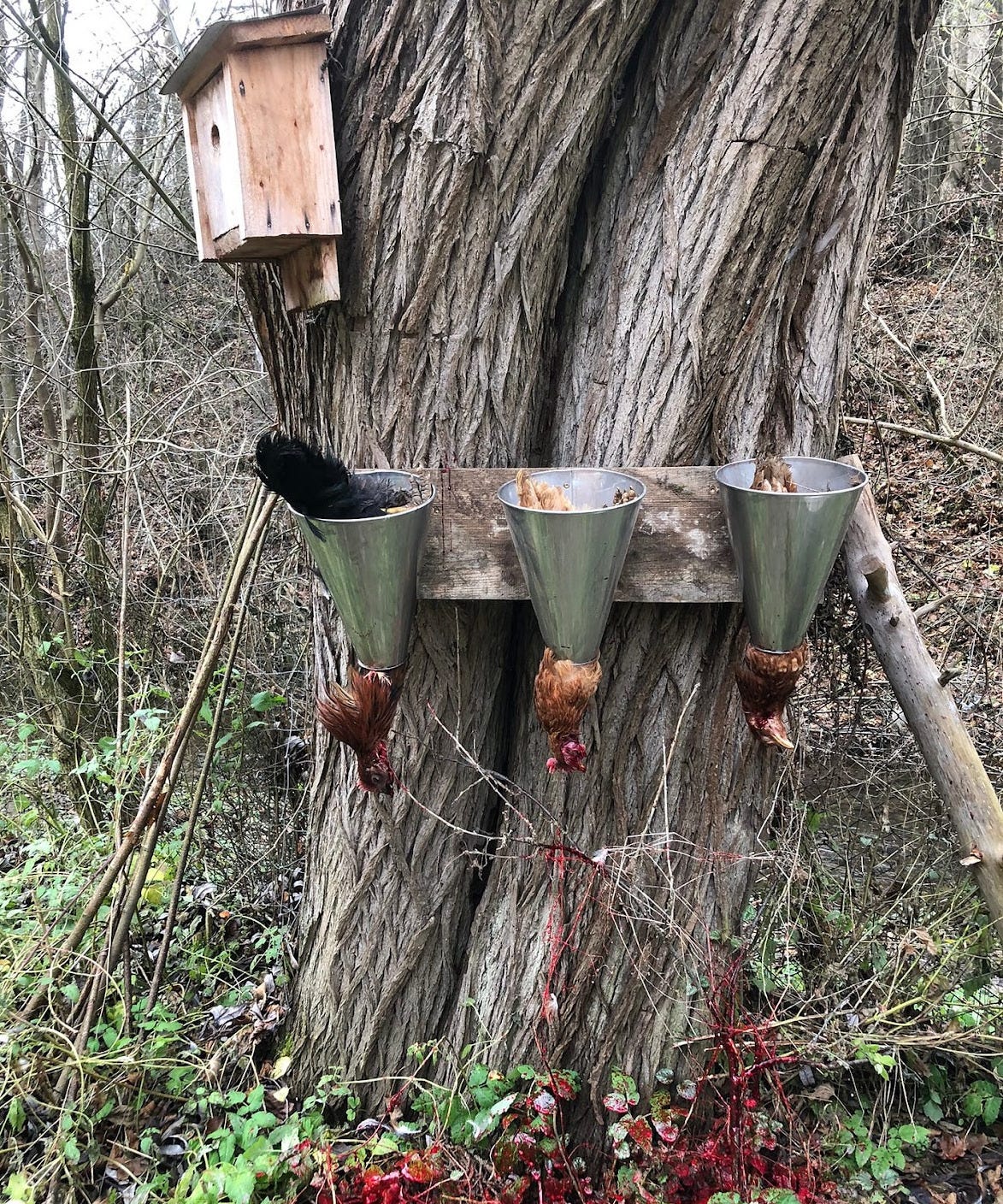
Sharpen a couple knives, dip my pinky into the steaming hot water on the stove, take a deep a breath. One by one, I take them out of the crate, give them a pet on their back, and thank them for their eggs, compost, manure, entertainment, and broth. Then a take them by both feet, turn them upside down and lower them through an upside down aluminum cone. Pull their head down by their comb till their neck is stretched tight, and draw a knife along the bow of their jaw. Blood lets out, warm and sticky, bright at first, then turning to a maroon red, staining, then soaking into the damp moss growing up the shady side of the tree stump.
From what I’ve been told, once the blood is flowing, the chickens are dead within seconds. I sometimes doubt it when they manage to kick themselves upright and hang with one wing over the side, and shake their half severed necks so blood spatters everywhere. They sure look alive. But I know they’d behave in such a way, even without their heads. My Oma used to tell a story about how when she was a little girl, her grandmother chopped a chicken’s head off for a stew in their basement. It ran around in circles spurting blood everywhere for half a minute. That memory lasted her a lifetime. I assume anything without a head is dead.
Most of what I do day to day in running our farm and homestead is work that I enjoy doing. Often times it doesn’t even seem like work. Killing, plucking, and cleaning hens feels like work. Though the work isn’t fun, I’ve had worse jobs, like selling women’s shoes in a shopping mall. There are few things more valuable for our family than a freezer full of our own livestock. Or, in this state, deadstock?
Yes, it’s meat. I know you’re not supposed to joke about killing animals. I learned this when we named our pig Sir Francis Bacon (we called him Frank). When killing farm animals is brought up around polite society, the response is often a shallow somberness, even slight disgust. This is, mind you, from people who eat meat, who just laughed with friends while eating a burger, a third of which ends up in the trash can.
Then there are those that think it’s more humane, or healthier, or “eco-friendly”, or just want to control some aspect of their lives, or display their virtue, or conscientiousness, for not eating meat. Well guess who ate that thrown out burger? The chickens who laid the eggs you just bought. Chickens love meat. Give a hen a choice between a worm or a sprouted grain, it will go for the worm every time.
And if you only eat plants, I’ve got news for you, plants love meat. Drop a fish head or pour chicken blood at the base of a tomato plant and watch what happens. GMO soybeans shipped from South America, processed in a factory into tofu, and wrapped in plastic, is not reducing suffering, or “good for the planet.”
But you’ll hear that phrase repeated like mockingbirds. We did too, my wife and I. Before we started a farm, we flirted with vegetarianism. But what we realized once we started growing our own food, and understanding the flow of energy, is that if we are to have anything resembling a permanent system of agriculture, animals are a necessary part of it.
The problem comes not in eating meat, but in buying meat that is from tortured animals. You are what the thing that you eat, eats. If that animal was fed industrial, toxic garbage, what’s that make you? If it suffered in life and death, does that suffering not become a part of yourself?
An uncomfortable fact of life is that some things have to die for others to live. To some, the cow that’s killed to make a burger is a tragedy, a crime even. They eat bread, or soy, and say it’s good. They’ve never watched a flock of ravens follow a tractor, feasting on the shredded remains of nesting birds, moles, rabbits and worms. Or felt the specter of pesticides drift over a field, which smell like paint, and poison every living thing in its wake. Is there not death is that loaf of bread? In that can of beans? Isn’t how the animal lived just as important as how it died? If in life and death, it was treated well, and died without suffering, then what’s wrong? To ignore the circumstances of the life and death of an animal, and construct a diet around categories of food, is just blind ideology.
My three-year-old daughter joined me for a while. I wasn’t sure how she would react, but she was interested, and asked a lot of questions. Why are you killing the chickens? Why do you put them in hot water? Will there be a whole egg inside them when we cut them open? Why don’t we eat the heads? A very good question. We feed them to the cats, but next time we’ll add them to the broth. She helped me pull their feathers off after scalding them, but mostly just followed me around and watched and listened as I told her what I was doing and why. When I had killed the last one, she asked if we shouldn’t bring more to kill. She likes broth.
I don’t feel good about killing our farm animals. Though, it doesn’t keep me up at night either. In fact, I sleep much better knowing we have a freezer full of meat, that when simmered on the stove, yields a thick broth, the kind that fills you up, cures a cold, or a hangover; the kind of broth with a layer of yellow fat on top, that seizes into gelatin when it cools down.
And when it’s my job to clean the bird, to strip the meat from the carcass, I clean it like one would eat a crab. I scrape the lungs out of the cavity, along with the tiny boiled yokes of eggs that will never be laid, and peel the thin strips of meat from the vertebrae. I dig with my nails into the crevices between joints, chew on cartilage, and suck the marrow from the bones.
And if that sounds weird, or like it’s too much, maybe you should draw the knife sometime. Or think about the person you pay to do that dirty job for you. And after that, spare a moment for the meat on your plate, that was once a living, breathing, feeling being. You might feel somber. Sit with that for a moment, but only for a moment. And then give thanks.
-BG
Fantastic. Real life, real living and I've experienced everything you've documented. It is a law of nature that for something to live, something must die.
Nicely done. Entirely convincing. And appropriately, delicately but firmly condemning. I DO envy your ties to your land, your food, your world, doing what I can with my place in it all.