
When a Fox Brings Dinner

I stand scratching my belly, staring north out the window at the sheep grazing the hills opposite our side of the valley. The dry grasses on the steep slope are lit orange by the morning sun, a pale blue sky hangs like a sheet above it. The frost has long turned to dew. Our garden, in contrast, stuck in a four-month perennial shadow at the bottom of a steep slope, looks dark and cold, the grass stiff and white with frost. Normally, I’d be out already, doing the morning chores, feeding the chickens, but a four-day-old baby put a stop to normal for the time being.
I start to turn away from the window when a flash of fur catches my eye. A fox comes trotting through the gate towards the house like she owns the place, crossing the garden with a black chicken clenched between her jaws. She looks like she is smiling. The fox that is, not the chicken. The chicken looks dead, but I don’t take much time to assess the situation from the window.
Still not fully awake, I say something that sounds like, “What the fox!” Take one step one way for my pants, decide I don’t have time, and spin around towards the door.
Lucie is sitting up in bed, back against the window, baby on her breast. She cranes her neck to look out the window, and our three-year-old jumps on the bed to see what is happening.
I stumble out the door in my underwear and slippers, and all I can think to do is yell, “Hey!”
The fox turns her head mid-trot, sees me, drops the chicken, starts to run, then turns back, hesitating for a moment with her paw in the air, not wanting to give up her prize. As I jump off the porch, she takes off across the yard through a gap in the fence, up the hill, and into the forest. I hurry over to the chicken, my feet crunching on the frozen grass. Her eyes were open, but I know she is dead when she starts flopping around like a hooked fish on a boat deck. I watch her for a moment, recalling the time I killed a feisty young cock who was too aggressive with his ladies. I laid his neck under a shovel handle, thanked him, put both boots on the wooden handle, and pulled on his legs till his neck broke. When I put my hand atop his wings to hold him still, a shock of pain shot up my arm, like touching an electrical socket. I still don’t know what that was.
A sinking feeling of dread takes hold as I think about the rest of the flock. Rarely has a fox come and killed only one chicken. On the few occasions it’s happened, it was usually a massacre. Foxes are sadists. They kill everything they can, seemingly just for the fun of it, and then ferry the dead, trotting on the sticks, one by one to their den until the sun comes up.
I don’t want the blood to settle in the meat, so I lift the still flopping hen by the legs and lay her across the raised flower bed next to the outdoor kitchen, pluck a knife off the magnet, hold her skin tight down her neck, and draw the knife below the bow of her jaw. Blood lets down the side of the empty flower bed, staining the wood dark red.
I turn and hurry to the chicken run, expecting the worst–dead bodies strewn everywhere, feathers, and blood. How could this happen!? Did she get in the coop last night? I knew I shouldn’t have trusted that automatic door on the coop! Damn Chinese-made garbage.
I am soon apologizing to the Chinese when I find an otherwise unharmed flock. They don’t even seem nervous or afraid, as you might expect when you see one of your family members get carried off by something with canines. Maybe they didn’t like that one, wanted to get rid of her, talked her over the electric fence? The fence. Was it on? Where did the fox get in?
Following the mobile fence line around the forest, I came to a sagging corner. The pole was bent within a few inches of the ground. The freeze-thaw cycle had worked the metal spike loose. Like a Comanche, I bend low to the ground, raking the dried leaves around with my hand, looking for tracks, but don’t find any. Though that doesn’t mean much, I’m no tracker.
I complete the loop along the perimeter of the fence and conclude that I had found the point of entry, and likely, exit. Though, strangely, it wasn’t the usual crime scene of feathers strewn around. This was premeditated, a clean hit job with a bungled escape route past the house.
The electricity is on. I discover that when I hastily try to set the fence back up, and receive a jolt that makes me yelp. Turn it off, set up the fence, flip it back on, the entire time tripping over the flock of chickens that were eagerly following me, letting me know in clear terms that they are very hungry.
Toss one bucket of wheat on the first pile of compost, steaming despite the cold. Much of the grain gets kicked into the decomposing materials, where it absorbs the water and heat, causing it to sprout within a day. The chickens eat it dry, but they like it better sprouted. It’s better for them, too, more digestible, more nutritious.
Empty a bucket and a half of their mixed feed into an old gutter suspended from the ground a few inches by wires. If they try to jump on the gutter, it swings, and they fall off. This way they can’t kick the feed around where much of it would get wasted. A friend of mine puts it in a gutter on the other side of a fence, so they have to lean through it like cows in their stalls.
Open the spigot, what Czechs call the “kohout,’ or rooster, and nothing happens. It’s frozen. I let out a breath and follow the vapor up to the canopy of hundred-foot-tall alders gently swinging in the light breeze. I hadn’t noticed they were planted in straight rows until our neighbor thinned out the understory last winter. This bothered me at first. I guess it was because it didn’t seem natural, a forest in straight lines. But then I met the owners, well into their nineties. The lady told me her grandfather planted the trees to be cut continuously to fuel their tractor.
“Your tractor ran off of wood?” I asked.
“Lots of machines ran on wood before and during the War. I knew how to drive it when I was twelve. Neighbors used to ask me to come plough their gardens in Spring. They’d pay me, too, which I found so funny. I would’ve done it for free. I liked driving that thing around so much.
“Why were these trees left to grow so big? You got a diesel tractor?”
“No. The communists came and took everything.”
The land was returned when the regime ended, yet in this time of freedom, they aren’t allowed to cut the trees on the land they own. They’re so old and big, they’re protected by the State.
I’m glad they’re here, and I hope they remain. They make me feel small, like a squirrel, and they shade the garden from the hard western sun during the summer. I think the chickens like them too. Those little jungle birds from Southeast Asia they feel right at home under a tall canopy.
A few carrots left in that bed, nice bunches of celery and parsley there, I take stock of what I’ll harvest as I walk through the garden to the stream, two water jugs in hand. Step carefully on the woven carpet roots of an alder, dip the jugs into the stream, examining the little icicles forming on the roots right above the surface of the flowing water.
Pour the water into the big plastic tub, then back the wheelbarrow to the gate of the chicken’s run as they close in around me. They know what the wheelbarrow means. I kick the gate open, and it slams back, thumping me in the back. The ground swelled in the cold. I wiggle my way through the narrow opening and go up the hill to the main gate. My key won’t turn the lock, so I remove my glove and cup the lock in my hand. The metal burns as it sucks the warmth of my body. It thaws enough that I can turn it. Cold tax paid, I head up to the brewery.
As I cross the little wooden bridge to the brewery, I call a greeting out to the owner, who’s supervising his two goats grazing on the low-hanging branches along the quiet road. We live in a hollow, what Appalachian people call a “holler.” No cars come down this hill unless they’re coming to the farm, the brewery, or the neighbor who lives between us.
I empty the trash can full of potato peels, dumplings soaked in gravy, and bits of meat, and wheel it back to the chicken run. They attack it like sharks in a feeding frenzy. Someone left a bag of eggshells at the gate. I empty them along the fence, and some of the hens immediately start devouring them. A few chickens in everyone’s backyard, and there would be no wasted food.
I watch them eat for a moment. What if the fox returns for her chicken? Our chicken. I hurry back through the alder forest to the outdoor kitchen, and there she is, just where I left her. I fill the big glazed pot I found at the dump with water, turn the knob on the gas stove and light it, then head inside.
The moment I enter, Marie is at my feet, asking every question you could imagine a three-year-old would have about what’s happened. “Daddy, where do foxes live? Do they bite? Is the chicken hurt? Why are there foxes?”
I try to answer as best I can as I wash my hands and look up into the mirror to find a big grin across my face. I pick her up, recruiting her to help me make breakfast. We cut up a couple apples, throw them in the pot, add butter, cinnamon, honey, raisins, peanut butter, oats, and raw milk. The entire time I stir, then serve, and then eat, we talk about the fox and the chicken, detailing the events, forming it into a story, until, by the end of breakfast, Marie is the one running outside, yelling, “Hey!” to the fox. Lucie rocks the baby, thoroughly amused.
After breakfast, I check the water in the pot on the outdoor stove by dipping my pinkie in it. Very hot, not yet boiling. Perfect. I dunk the hen into the scalding water, holding her like Achilles’ mother, plunging her up and down so the water finds its way under her plumage. About a half minute of this, and I set her on the table. I test the wing feathers first. If those pluck out easily, no need to dunk her anymore. They do, so the plucking begins, no doubt the most time-consuming part of butchering a bird.
Within five minutes, she’s naked. Drag a knife along a sharpener a few times, then make a small cut above the cloaca. A chicken’s only got one hole down there. When laying an egg, the vagina flips inside out over the tract of the cloaca so that the egg never comes in contact with the feces. If that’s not intelligent design, then I don’t know what is.
There’s more tearing than cutting in cleaning a bird. From the small cut above the vent, I pull down on the pelvis and up on the ribcage until I can stick my hand inside the still-warm cavity. The first thing I feel is smooth and hard, a fully formed egg. The oviduct is full of them, each smaller than the next, like Matryoshka dolls, all eggs we will never eat. I set the fully formed one aside. We will eat that one.
In one handful, I pull out the insides so that everything hangs over the table, cut off the liver, heart, and gizzard, and put them into a boil for the soup. Make a ‘V’ shaped cut from the vent to the tailbone, and everything else falls out into a bucket with the feathers and apple cores from breakfast. All this will be fed back to the flock.
Roll the knife along the knee joints, stick the tip in the middle to sever the tendon, and they each pop off smoothly. I cut the head off with strong scissors. Butchered pig is called pork, and cow is beef. Chicken is just chicken. This hen is scrawny, like the whole flock. Meat birds, or broilers, are an entirely different breed. Most chickens eaten nowadays are less than eight weeks old. They convert all of their food into mass. Our chickens convert their food into eggs, not meat. Hence, why this hen is scrawny, and why egg layers are always destined to be a pot of broth, not a baked bird. Czechs say that the best chicken soup for recovering from an illness should be an old egg layer, not a broiler.
I stick the dismembered bird into the fridge to make sure the cats don’t steal anything, empty the bucket in the chicken run, and go to the stream to wash my hands. I find a garden fork and pry up the rest of the carrots at the end of a bed, then cut the parsley and celery, and find some forgotten parsnips in another bed.
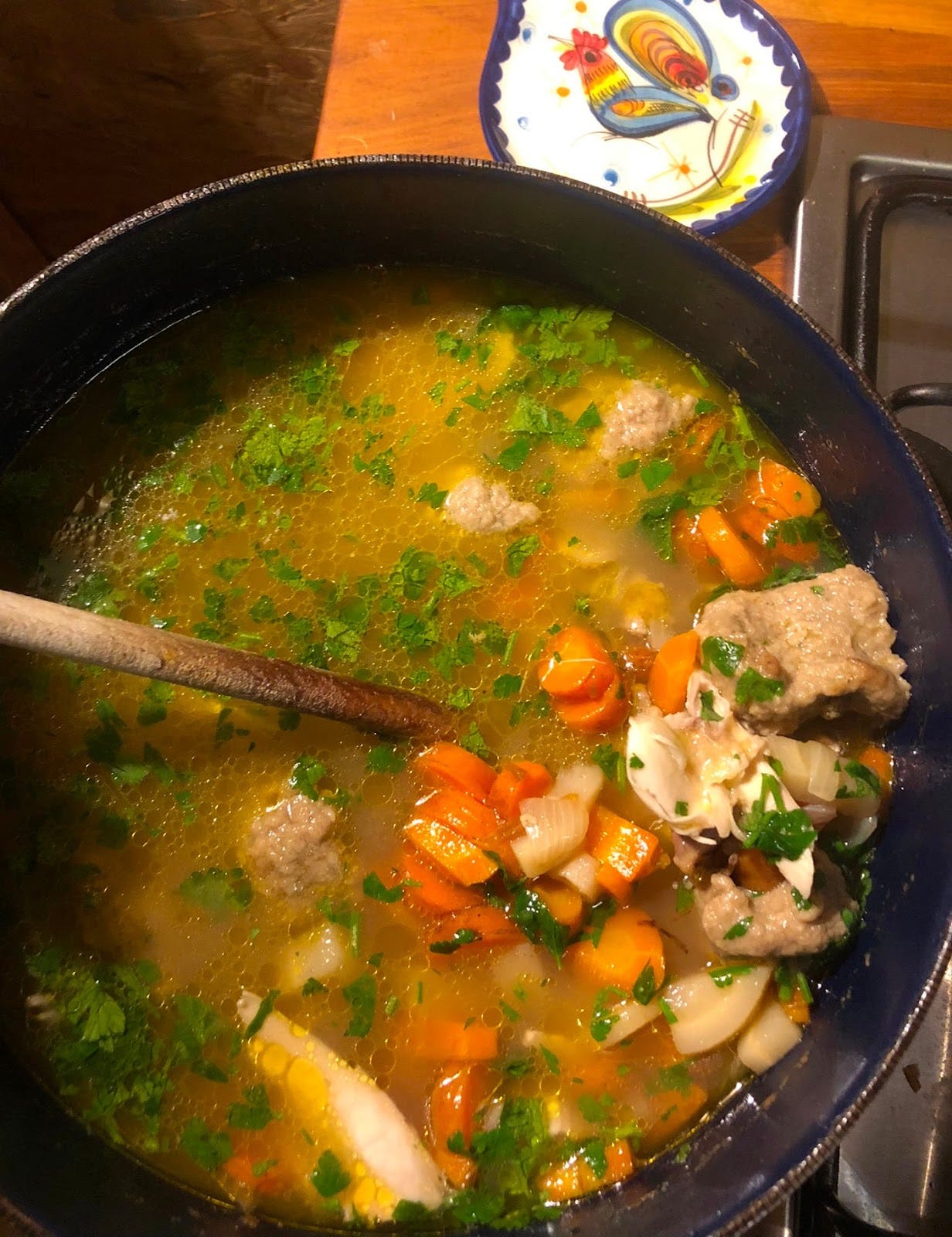
It’s almost ten by the time everything is washed, chopped, and salted. The cast-iron pot is placed on the wood stove, where it will humidify our home with the lovely aroma of chicken broth as we settle into our new life as a family of four.
In the evening, we call Aunt Kerri in America, and Marie puts on a theatrical performance telling my sister all about the fox and the chicken and how she ran outside, stomping one foot, yelling, “Hey!” to the fox, “That’s our chicken!”
When we sit down to eat, we thank the fox for bringing us dinner and, more importantly, a story that will be remembered and told in the family lore for a long, long time. And my, was that soup good.
Did I read correctly that all of this happened without any pants on? LOL
Lovely story. My youngest came in from gathering eggs one day to announce a gosling in the nest box. Pip the wild goose lived with us for a few seasons and the geese are now Pipkin to me.